
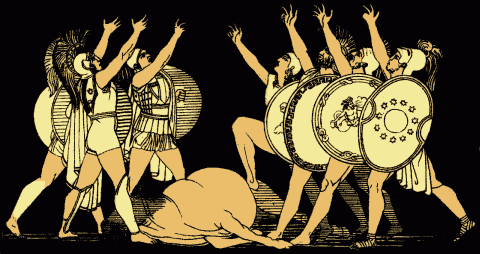
The oath of the Seven Princes, an illustration by John Flaxman, from A. J. Church "Stories from the Greek Tragedians."
Emperor Domitian and epic poetry
Emperor Domitian, who assumed power in A.D. 81, cared as much for the development and promotion of culture as he did for the development of an efficient system of internal espionage. He spared no cost to return great Roman libraries to their former glory, a glory which they had lost due to fires and military coups in the preceding decades. He ordered copies of rare books to be brought from all around the world. He even sent teams of scribes to distant Alexandria so they could copy works that could not be found elsewhere and compare and correct texts of ancient authors. Among the many buildings the emperor restored or rebuilt were temples and sporting facilities and a great concert hall, the Odeon.
In A.D. 86, he organized grand games on Capitol Hill in honor of Jupiter. The games consisted of three parts: there were musical competitions, equestrian competitions, and wrestling. The term “musical competition” did not mean performances by instrumentalists and singers alone but also recitations of literary works by their authors who presented works in prose and verse, both in Latin and in Greek. The emperor himself presided over the Capitoline Games, which, henceforth, took place every five years. The emperor also founded other games in honor of Minerva, the goddess of arts and crafts. These were more humble; their location was not in Rome but in the imperial villa on the Alban Lake; but they were more frequent—they took place annually—and they also included competitions of poets and public speakers.
The emperor himself took no interest in literature whatsoever. He read nothing—no poetry, not even historical works—except the most recent history, and even that in a very narrow aspect: he frequently read the memoirs of Emperor Tiberius and the documents relating to the period of his rule. There was a good reason for this: Domitian searched for examples and advice on how to deal best with opposition. And in this regard, Tiberius could serve as an excellent example! It was he, after all, who sentenced to death a poet in whose poem he found words abusing Agamemnon, the commander of the Greek army at Troy. That was a very distant past, true, and merely mythical, but the rule Tiberius followed was simple: no one was allowed to offend a ruler.
But Domitian—a far more perceptive mind than it is usually admitted—soon realized that repression and punishment alone were insufficient and that to ensure that writers fulfilled the goals set for them, one needed a carrot as well as a stick. That is why the emperor took such care of libraries and ancient monuments; and why he founded poetic games and awarded generous prizes. Domitian reasoned that men of the pen are in equal measure fearful of punishment and desirous of praise. Taking advantage of these two facts, a ruler can count on the complete submission of the creative circles and expect an eternal glory as a sponsor of culture. A similar thought had guided emperor Nero. But he was lost by his own creative ambitions: he wanted to write, sing, act on stage, and receive applause himself. These artistic activities undermined the ruler’s authority and awoke envy—worse, hate—of the writers who could not, after all, compete with the emperor on equal terms.
Domitian acted more wisely. Though he had received a thorough education, and though in his youth he had committed some sort of poetic works, in later life he did not even write his own letters. Everything was done by his secretaries. As a ruler, he wanted only to be the judge: liberal with those who appreciated the greatness of his times but strict with those who stubbornly insisted on a narrow interpretation of civil liberties. Any author who dared to praise any member of the opposition (even one already dead) paid for it with his life and the destruction of his books: they were publicly burned by the executioner. And, just in case, Domitian exiled all teachers of philosophy from the capital. A writer, who had lived under Domitian in his youth, wrote later:
Former ages have seen the apex of liberty, but we—the nadir of slavery; because police oversight denied us even the possibility of communicating with one another. Why, we would have lost our memories, too, if it had been in our power to forget as it was in our power to remain silent.
But are these severe words justified? After all, it was enough to express an appreciation for the blessings of the rule of Domitian and, why, one could write freely and even receive awards. Many subtle minds have quickly realized this. Quintilian, the famous professor of rhetoric, a brilliant expert on literature, theoretician of culture and education (and a tutor of the grandsons of Domitian’s sister), discussing the greatest Roman poets in his work entitled Institutio Oratoria (On The Education of Public Speakers), allowed himself this hymn of praise:
I mentioned only these [works of] Germanicus Augustus [that is, Domitian] because he was called away from his literary projects by his concern for the wellbeing of the world. Gods had not wished him to become one of the greatest poets. And yet, is it even possible to find anything more sublime, more learned, and in every way more perfect than these works, which he had composed as a youth while he still allowed others to rule the Empire? For who could have described wars better than he who led them so expertly? Who would be listened to more attentively by the goddesses in charge of literature? And to whom could the goddess Minerva have lent more readily her powers, she who favors him so much? Future generations will be able to say more about this because, for the time being, his other virtues, with their blinding light, outshine the glory of his literary talents. But surely, you shall forgive me, O Caesar, if I, a priest of literary perfection, do not pass in silence over your great contributions in my field!
In other places of his work, Quintilian invoked the name of his emperor the way other poets may invoke the name of a god.
But all of this is nothing compared to the praises heaped upon Domitian by certain other poets. The first place in this competition no doubt belonged to Martial. Nearly every year during the reign of Domitian, he sent into the world a new collection of witty epigrams; the main objective of these collections was to win the poet the favor and gifts of powerful lords and of the emperor himself. This is why they are full of the crassest groveling. Martial stated clearly why he occupied himself with poetic production. Let us open, say, the dedication of his eighth book, published in A.D. 93. These are its first words:
To Emperor Domitian Augustus, vanquisher of Germans and Dacians; Martial; greetings:
Although all my little books (which owe their fame, and therefore life, to you, my Lord) pay homage to you; yet this, the eighth, more so than the rest, takes the opportunity to relieve the need of the heart. Creative writing takes a smaller role here, yielding to the importance of its subject. I have merely tried to vary these poems a little with a small admixture of jokes so that not every poem contains praise of your divine humility; which praises would surely tire you sooner than satisfy my heart.
A far more interesting personality—both as an artist and a man—was Papinius Statius. He was born in Naples, where his father ran a well-regarded school of rhetoric. Later, the family moved to Rome. Statius owed to his father not only a thorough education but also his love of poetry. He began to take part in public contests at a very young age and won his first poetic prize while still a boy. But true fame came to Statius only through his victory during the games in honor of Minerva at the Alban villa of Emperor Domitian in A.D. 90. He presented a work describing the ruler’s (imaginary) victories on the Danube and the Rhine. Three years later, he competed in the grand competition on Capitol Hill, but he did not win any prizes. He suffered greatly at this setback. It may be why he moved back to his native Naples.
Those who did not own property could not support themselves with poetry alone, even if they enjoyed the kind of fame that Statius did. At the time, poets earned their living by running bathhouses or bakeries. Others worked as men-at-arms in courts, while others yet vegetated as ordinary market-stall keepers. Statius made his biggest financial killing writing libretti for dance performances of a famous mime. Therefore, one can easily understand and forgive the eagerness with which Martial and Statius sought out the emperor’s favor. But perhaps Statius was motivated by the desire to establish himself as a thoroughly loyal subject so as to be free to devote himself entirely to the sort of production he considered the appropriate goal of his life. Unlike Martial, Statius did not limit himself to trivial occasional verses. His ambitions were far greater.
For twelve years, he worked on an epic. Its title was The Thebaid, and it described the first expedition of seven against Thebes. Statius published its twelve books in installments, but sometimes he also gave public declamations. On such occasions, huge crowds gathered to listen. Right off, the work was received well, even enthusiastically. Many young poets learned whole books of The Thebaid by heart. Some compared the epic of Statius to The Aeneid, even though its author considered himself only an inept epigone of the great Virgil. Admiration for The Thebaid lasted for the rest of antiquity and well into the Middle Ages. It was one of the most frequently read epics. Along with The Aeneid, it was one of the fundamental works upon which the poetic taste of the young was trained. People drew from it knowledge of mythology, metaphors, and the rules of composition.
A late medieval legend made Statius a Christian. Dante, led by Virgil and visiting the Purgatory, met the author of The Thebaid in the fourth circle. Turning to Virgil, Statius confessed his sins as follows:
Already was the world in every part
Pregnant with the True Faith, disseminated
By the apostles of the Eternal Kingdom;
And what you said is God’s own truth,
Just as these preachers of the Word announced;
And so I took to visiting them.
And then I saw how holy they were,
And when Domitian persecuted them,
I did lament their fate with tears;
And for the rest of my days on earth,
I befriended them, and their upright ways
Made me shun all other teachings.
And while in my poetry I took the Greeks
To ancient Thebes, in my own life I was baptized.
But out of fear I kept my Christianity a secret,
And for a long time outwardly professed paganism;
And this lukewarmness of my heart
Sentenced me to this fourth circle.
Of course, there is not the slightest proof that Statius was a Christian. But the legend is telling: it shows the general admiration for his poetry held in the Middle Ages. But today no one—except philologists—bothers to peek into this great epic, which, for fifteen centuries, passed for one of the greatest achievements of literature.
When writing the epic, Statius drew upon various mythological sources familiar to him as well as upon the more recent epic of Antimachus of Colophon. But he does not seem to have used as his source that ancient Thebaid, written in the style of the aoidoi, and for that reason attributed by some to Homer. In some cases, Statius developed or changed some elements of the story. And thus, we find in his Thebaid a description of how the god Mercury descended into the netherworld to summon the ghost of king Laius. There is a generous treatment of the theme of the death of Archemoros. (This was that child which Hypsipyle had lain in the grass when she guided the princes to the spring). And the life of Hypsipyle herself Statius tells according to the version of Euripides.
What led Statius to this particular choice of subject for his epic? The easiest answer would be that he simply followed tradition, which demanded that an epic be situated in mythical times. And the expedition of the seven against Thebes, full of dramatic developments, somber and bloody, must have seemed an appealing material. After the Trojan War, the Theban cycle of myths supplied poets and sculptors with the greatest number of artistic motifs.
All of this is true. But it is worth remembering that many Roman epic poets, ones close in time to Statius, did not turn to stories that were either Greek or mythical but sang events from Roman history. Of them, the most famous was Lucan. He lived in the time of Nero and chose as a subject of his epic the history of the civil war between Caesar and Pompeius. Its near contemporary was an epic about Rome’s struggle with Hannibal; its author was Sillius Italicus, an old man by then but once a great statesman.
Lucan did not hide his sympathy for Pompeius and Cato, two great defenders of republican liberties—and these political allusions later contributed to his death. But he had not limited himself to fighting tyranny with words and had also taken part in a plot against Nero. Statius preferred to act more circumspectly. He delved into a past so ancient that no one could possibly look for any relevant political allusions in it.
Despite this, The Thebaid’s success did get him into hot water. It appears that the emperor let it be known that, in his opinion, such a great poet should better use his talent to glorify not the works of ancient heroes but the memorable events of contemporary history—the great victories of Domitian! The ruler’s fatherly advice would certainly have had the desirable effect, but before Statius could turn his mind to the worthy task of singing the imaginary glories of the true tyrant, Domitian was murdered.
Happy days of freedom of thought and speech followed. Statius immediately returned to epic poetry: this time, he chose as his topic a hymn about Achilles.
[1] Tacitus, The Life of Agricola, 2
[2] Quintilian, op. cit. X 1, 91
[3] Martial. Author’s translation with some edits
[4] Dante, Divine Tragedy, Purgatory, XXII 76 and followinG
From Aleksander Krawczuk's Seven Against Thebes, the account of the horrific reign of Emperor Constantius and of the education of young prince Julian.
Aleksander's Antiquities
Explore antiquity through Aleksander Krawczuk's captivating lens.
CONTACT
NEWS
a.krawczuk@mondrala.com
+352691210278
© 2025. All rights reserved.